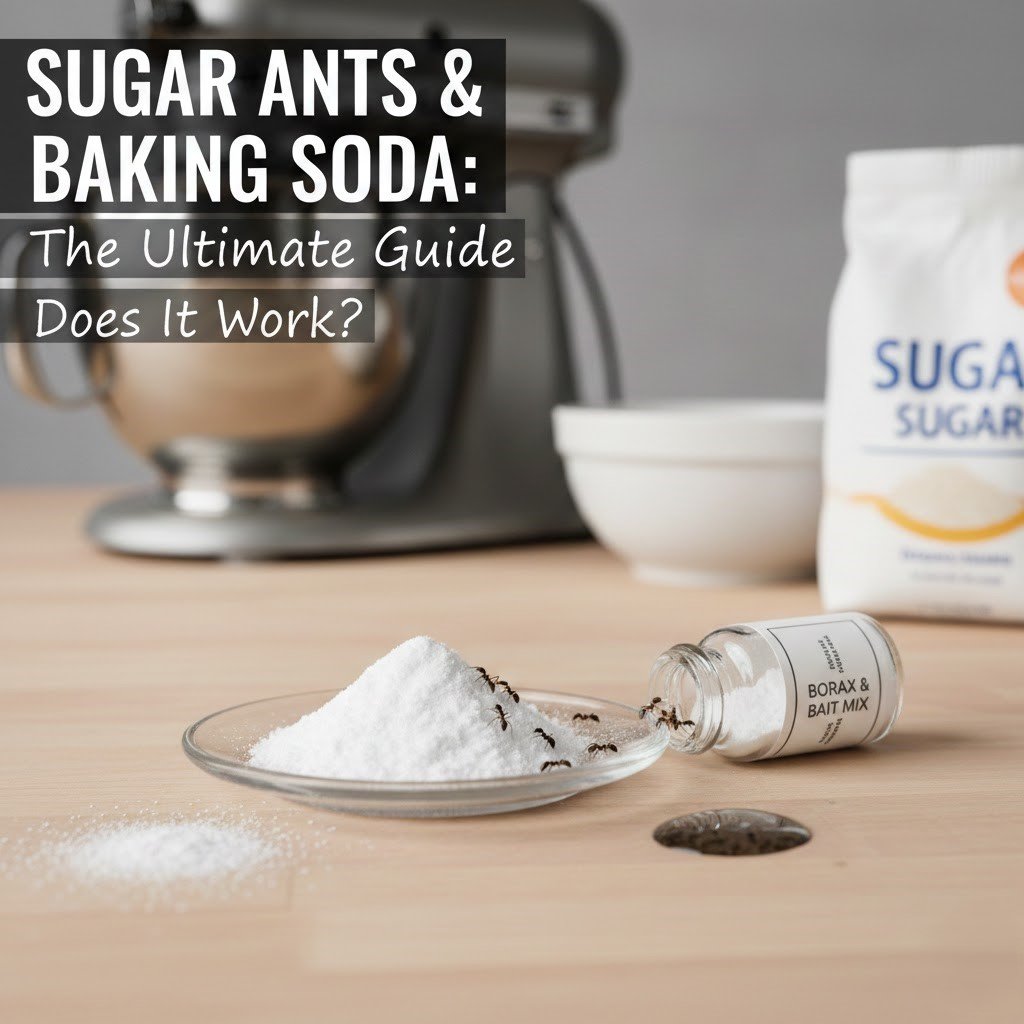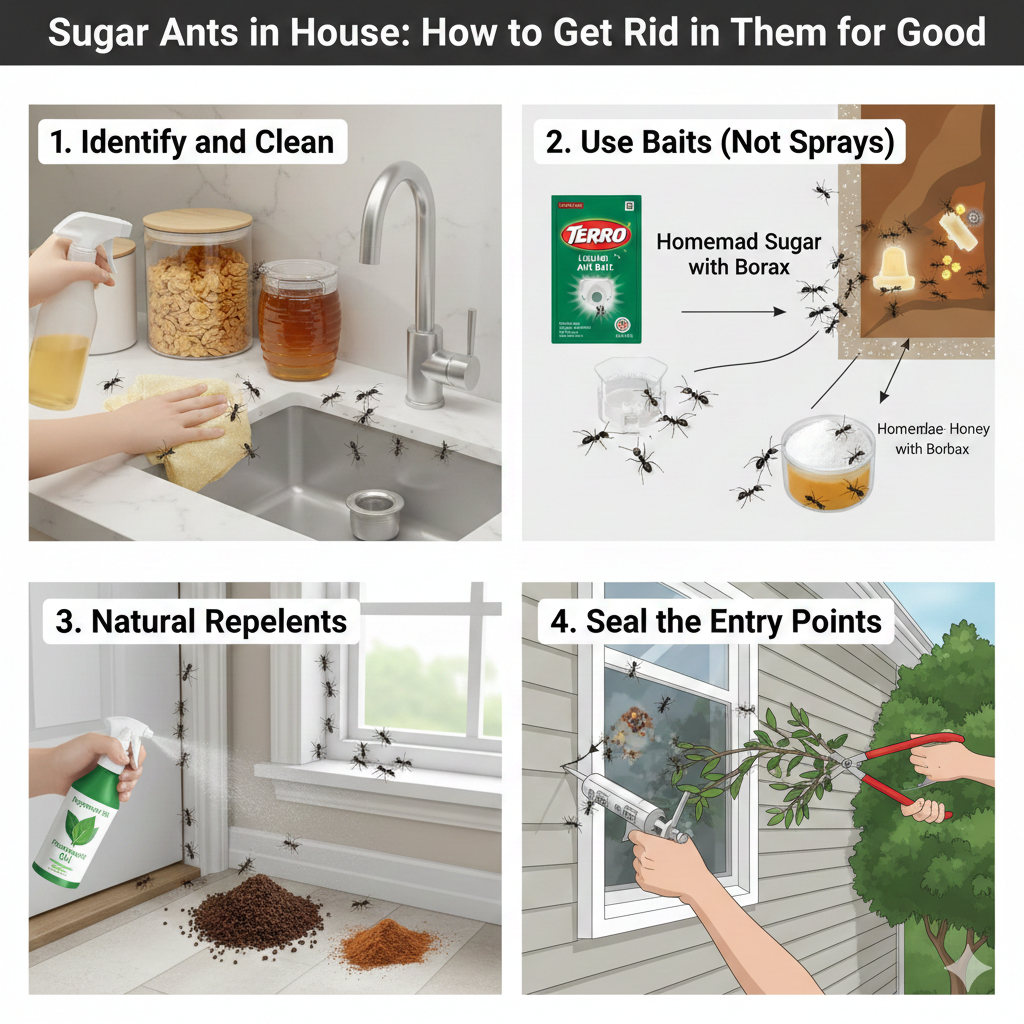
You are standing in your kitchen, reaching for the sugar bowl, when you notice a trail of tiny black dots moving across the counter. Your first instinct is usually one of annoyance—now you have to clean. But your second instinct is often a prickle of concern: Do sugar ants bite? If you have children or pets roaming the house, knowing whether these persistent pests pose a physical threat is your top priority.
The term “sugar ant” is often a catch-all phrase for several small ant species attracted to sweets. While their presence is a nuisance, the reality of their “bite” is often misunderstood. In this guide, we will break down the biological truth behind ant behavior, explore the question of whether do sugar ants bite humans, and provide professional-grade strategies to secure your home.
What Exactly Is a Sugar Ant?
Before we can address the danger, we must identify the intruder. In North America, what people call “sugar ants” are usually Odorous House Ants (Tapinoma sessile) or Pavement Ants. In Australia, the Banded Sugar Ant is a specific, larger species that actually belongs to the Camponotus genus.
Most common household ants are tiny—roughly 2.4 to 3.3mm long. Their primary goal in your home is survival, which means finding a reliable source of water and glucose. They are not predators in the sense that they hunt mammals; they are scavengers.
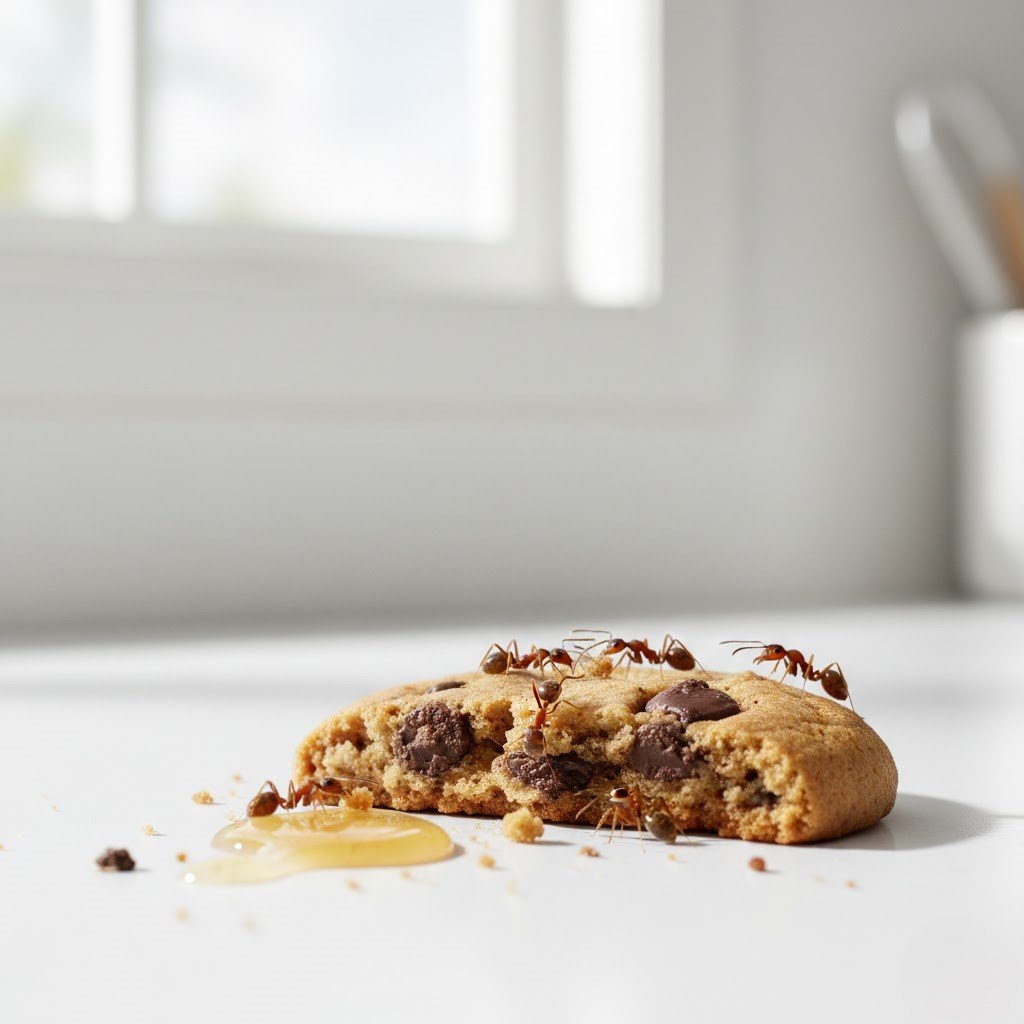
Caption: Understanding the tiny scale of a sugar ant helps explain why their bites are rarely felt by humans.
The Biological Truth: Do Sugar Ants Bite?
The short answer is: Technically, yes, but it is extremely rare and usually harmless.
Most species classified as sugar ants have mandibles (mouthparts). These mandibles are designed for carrying food, moving larvae, and occasionally defending the colony from other insects. However, for a human to be bitten by a standard Odorous House Ant, a specific set of circumstances must occur.
Why Ants “Bite”
Ants do not bite humans for food. If you experience a bite, it is a defensive reaction. This happens if:
- An ant is accidentally pressed against your skin (e.g., trapped in a shirt sleeve).
- You lean your hand directly onto a high-traffic trail.
- You disturb a nest located inside a wall or potted plant.
Because of their microscopic size, most household sugar ants cannot break human skin. Even if they attempt to pinch, you likely won’t feel it, or it will feel like a tiny, fleeting prickle.
Read More About: How to Get Rid of Sugar Ants Permanently: 10 Proven Methods
Do Sugar Ants Bite Humans and Leave Marks?
If you find red, itchy welts on your skin, the culprit is likely not a sugar ant. It is a common mistake to blame the visible pests (the ants on your counter) for the work of invisible ones (like bed bugs or mites).
| Feature | Sugar Ant “Bite” | Fire Ant Sting | Bed Bug Bite |
| Pain Level | None to very mild | Sharp, burning pain | Itchy, delayed reaction |
| Appearance | Rarely visible | White pustule/pimple | Small red bump in a row |
| Aggression | Passive/Defensive | Highly aggressive | Predatory (feeds on blood) |
If you are indeed wondering do sugar ants bite humans in a way that requires medical attention, the answer for common species is no. However, some people may have a mild skin sensitivity to the formic acid some ants spray when threatened, which can cause slight redness.
Health Risks: Beyond the Physical Bite
When we talk about “safety,” we have to look past the bite itself. As an expert in pest behavior, I often tell clients that the danger of an ant is not in its mouth—it’s on its feet.
1. Pathogen Transmission
Ants are “mechanical vectors.” This means they pick up bacteria on their legs while crawling through trash, drains, and outdoor soil. When they enter your pantry, they can transfer Salmonella, E. coli, and Shigella onto your food.
2. The Attraction of Other Pests
A massive sugar ant infestation can serve as a “buffet” for more dangerous predators. Spiders and centipedes are attracted to homes with high ant activity. By allowing an ant problem to persist, you are inadvertently inviting higher-level predators into your living space.
3. Allergic Reactions
While rare, some individuals are hypersensitive to the secretions of ants. If an ant is crushed against the skin, the chemical defense it releases (which often smells like rotten coconut) can cause localized irritation in sensitive individuals.
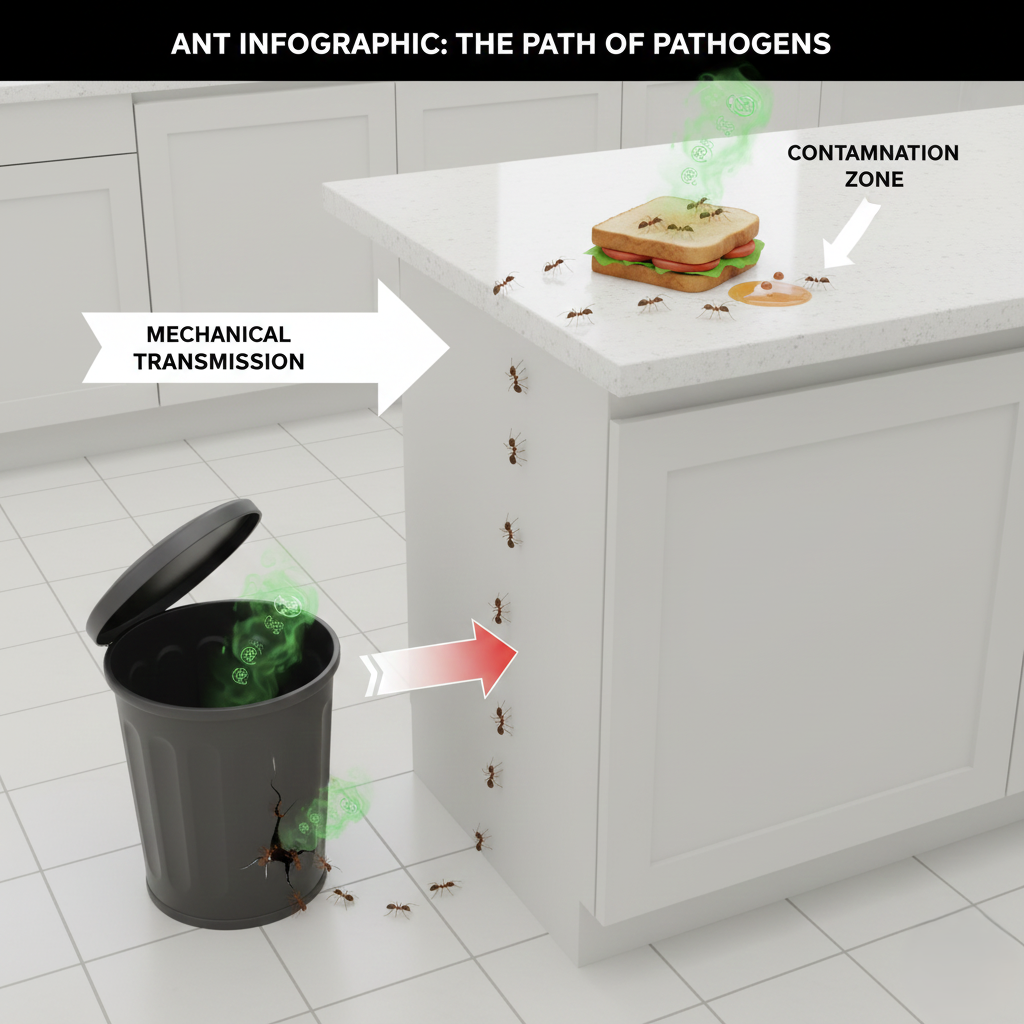
Caption: The primary health risk from sugar ants is food contamination rather than physical bites.
Expert Tips for Securing a Bite-Free Home
Prevention is the most effective form of safety. To ensure you never have to ask “do sugar ants bite” from personal experience, follow these professional exclusion steps:
Seal the Entry Points
Sugar ants can enter through cracks as thin as a fingernail. Use silicone caulk to seal gaps around window frames and door sills. Pay close attention to where utility pipes enter the walls under your sink.
Disrupt the Chemical GPS
When a scout ant finds food, it leaves a pheromone trail. Wiping them away with a dry cloth does nothing—the chemical remains. Use a mixture of white vinegar and water or a soapy solution to neutralize the scent trail and prevent more ants from following.
Manage Moisture
Many “sugar” ants are actually looking for water. Fix leaky faucets and ensure your bathroom vent is working correctly. A dry home is a much less attractive home for an ant colony.
The Importance of Proper Identification
If you are being bitten and the pain is significant, you may be misidentifying your pest. Carpenter Ants are often mistaken for sugar ants because they also seek out sweets. However, Carpenter Ants are much larger and have powerful mandibles that can break human skin and cause a painful pinch.
Similarly, if you see small, reddish ants in your yard that seem to swarm when you step near them, you are likely dealing with Fire Ants, which possess a venomous sting that can cause severe allergic reactions.
According to research from University Extension Programs, proper identification is the first step in any integrated pest management (IPM) strategy. Knowing exactly what species you are dealing with determines whether you need a simple bait or a professional structural treatment.
When to Seek Professional Help
If you have tried retail baits and the ants keep returning, you aren’t dealing with a few lost scouts—you have a deep-seated colony. In many cases, “DIY” treatments can actually cause a colony to “bud,” which is when the ants sense danger and split into multiple smaller colonies throughout your house, making the problem much harder to solve.
Professional pest strategists use non-repellent transfer technology that allows the workers to carry the treatment back to the queen, ensuring the entire colony is eliminated at the source.
If you are struggling with a persistent infestation and want to ensure your home is a safe, hygienic environment for your family, reaching out for an expert opinion is the most efficient path forward. Whether you need a diagnosis of a specific “bite” or a full-scale exclusion plan, we are ready to assist.
FAQ: Common Questions About Sugar Ants
1. Why do I feel like something is biting me, but I only see sugar ants?
You may be experiencing “static” or contact dermatitis from cleaning chemicals, or you might have a different, smaller pest like bird mites. Sugar ants are rarely the cause of mysterious “unseen” bites.
2. Can sugar ants bite my pets?
While they can, they usually won’t. However, if ants swarm your pet’s food bowl, the pet might get nipped while trying to eat. It is best to use “ant-proof” bowls that feature a water moat.
3. Are sugar ants poisonous?
No. They do not have venom that is dangerous to humans or pets. They are considered a nuisance pest rather than a medical threat.
4. What should I put on an ant bite?
If you have a minor reaction, washing with soap and water is usually enough. For itching, a dab of hydrocortisone or a cold compress will provide relief.
5. Do sugar ants bite more at night?
No, but you may notice them more at night when the house is quiet and they feel safer foraging in the open.
6. Do sugar ants live in beds?
Not typically. They only go where there is food or water. If you find them in your bed, check for any crumbs or spilled drinks nearby.
Conclusion
Navigating an ant infestation can be stressful, but when it comes to the question “do sugar ants bite,” you can breathe a sigh of relief. These pests are far more interested in your pantry than your skin.
- Bites are defensive, not predatory: Sugar ants only bite when they feel physically threatened.
- Contamination is the real risk: Focus on sanitizing surfaces rather than worrying about stings.
- Identification is key: If a bite is painful or leaves a welt, it is likely a different species like a Fire Ant or Carpenter Ant.
- Professional help works: If baits fail, a strategist can find the nest and stop the cycle.
By staying proactive with your home maintenance and keeping food sealed, you can enjoy a bite-free and ant-free home. Don’t let a small trail of ants turn into a large-scale concern—take action today to protect your living space.